Back in the day, it didn’t take much to be labeled a witch. Did you own a cat? Witch. Did you have a birthmark? Witch. Did you use herbs, wear a cape, know how to read or lure children into your gingerbread-flavored home so you could eat them for dinner? Witch.
I’m just saying, the bar was low.
Starting in the 1450s, witch hysteria swept across Europe, lasting for centuries. Intense warfare, hardship, famine and disease meant only one thing: it was time to burn the witches, because obviously.
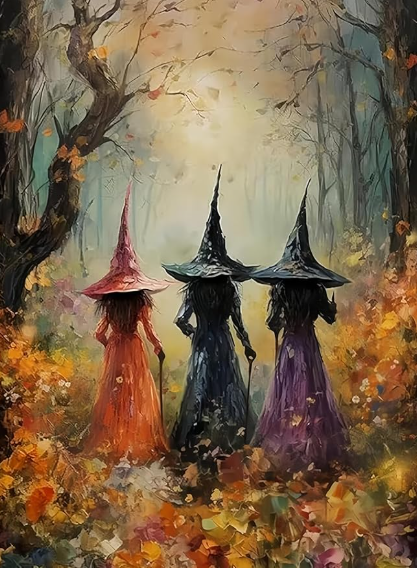
Nearly 60,000 people were tried and killed as witches. More than 80% were women and 60% were over the age of 40. It was a gendercide that wiped out generations of women. Many were healers, midwives, widows and property owners.
They’d reached a time in their lives where they were fine being alone, with maybe a cat or two. They just wanted a nice broom, a boiling cauldron of soup and a Pinterest board of “Witchy Reads.”
Many women step into their power once they hit 40, but give women power and there’s going to be trouble. Killing the older generations meant wisdom was lost forever, which is probably why we have mini golf sets for the toilet.
Like Labubu and Meta (and just as diabolical), witch trials were big business. Women were arrested, property was seized and people flocked to churches because no one wants to accidentally sell their soul to Beelzebub.
The witch trials also created a disconnection between women; a fear of gathering, the angst of being seen as a “coven” when all you wanted to do was watch the “Real Housewives of Salem.” Women stopped socializing because having a friend for tea could end in a hanging. (And you thought your book club was stressful.)
I’m a lover of all things witchy, a devotee of strong women using their magic for good. A witch is a woman who speaks truth to power, without shame. Imagine a combination of Dolly Parton, Oprah Winfrey and Ruth Bader Ginsburg, a woman so powerful even the Puritans would have been like, “Nope, not today.”
You see, a witch hunt creates a culture that undervalues women. When you describe women as shrill, chatty, feisty, mousey, sassy, emotional, slutty, hysterical, irrational or hormonal, those words strip away power.
How many of these words are used to describe men? Almost zero. At the worst, men get labeled as “grumpy,” and somehow that becomes “distinguished.”
There’s still a witch hunt going on today. Saying “women’s rights” to certain groups triggers frothing at the mouth and a call for the ducking stool.
Women want to be believed, heard and have the ability to live without violence or discrimination. We want affordable physical and mental health care, an equal wage and respect. Is that insane, deranged, unhinged or any other word used to lock women up in asylums, as recently as 1967?
A witch stands on her own. She embraces her age, her knowledge and her intuition, without fear. It’s not surprising that interest in witchy practices is rising. You can learn spells on TikTok, craft a voodoo doll on YouTube and banish your ex to the depths of Detroit using a candle, cayenne pepper and a squeeze of lemon. Science, obviously.
For women who have felt disenfranchised in their communities, religions and workplaces, witchy practices are a way to find their power. It isn’t an excuse to turn women into barbecue.
I associate magic with creation, and women are the ultimate creators. Women are magic, able to run empires, sing lullabies and look fabulous in a cape. Do you need someone to change the world for the better? Find a witch.
Originally published in the City Journals
 perikinder.com